

The Schließmann Strategy Cube adds a third dimension to classic strategic models: a company’s viability within its relevant system. It not only shows where a company stands in relation to its competitors, but also whether its current position and trajectory are sustainable in the long term.
Why Traditional Strategic Models Fall Short
Many well-known strategic models use two-dimensional matrices.
Examples include market share versus market growth or competitive advantage versus attractiveness.
These models help structure markets.
However, they overlook a crucial question:
Is the company itself structurally viable?
A company can
- have a strong market position
- be profitable in the short term
and yet fail in the long run.
The reason usually lies not in the market—but in the system.
Three Dimensions of Strategic Reality
The Schließmann Strategy Cube adds a third dimension to classic strategy models.
Strategic reality arises from the interplay of three factors:
1. Relative strength in the market
How strong is our position relative to competitors?
2. Performance in the relevant market
How profitable and sustainable is the business model?
3. Viability within the relevant system
How resilient and adaptable is the company itself?
The Strategy Cube
Together, these three dimensions form a three-dimensional analytical model.
The Strategy Cube shows the strategic state of a company.
This gives rise to nine possible fields of strategic reality.
For example, a company can:
- strong in the market, but systemically fragile
- be profitable but strategically misaligned
- innovative, but structurally unstable
The die makes these differences visible.
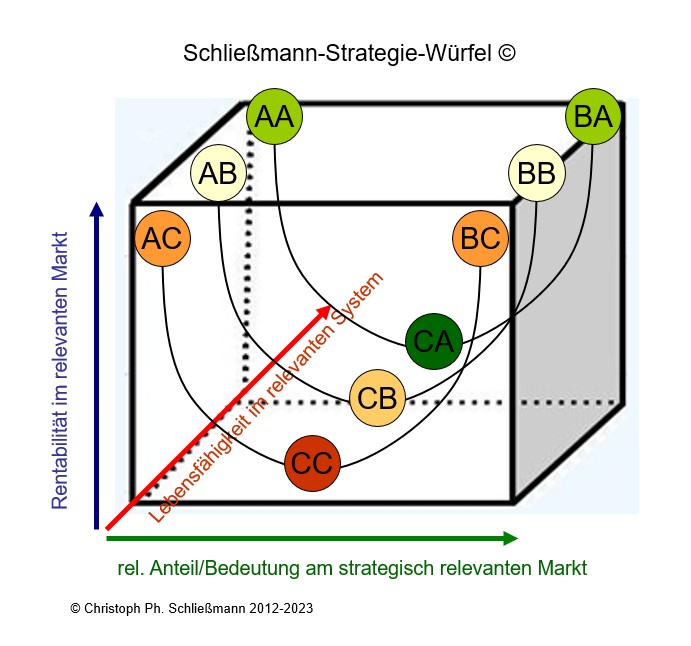
Figure: Schließmann Strategy Cube(based on Michael Porter) © 2012–2026.
Why the third dimension is crucial
Many companies do not fail because of their market strategy.
They fail because their organization is no longer suited to the market.
Typical symptoms include:
- increasing complexity
- decreasing controllability
- lack of strategic direction
The Strategy Cube therefore combines market analysis with system analysis.
It not only shows where a company stands in relation to its competitors, but also how stable its strategic framework is.
Strategic Implications
Depending on the position within the cube, different strategic tasks arise:
- Stabilization of a fragile system
- Repositioning in the market
- structural transformation
- Building on existing competitive advantages
The cube is therefore not just for analysis.
It is a tool for strategic management.
Strategic Analyses of the Economy and Markets
In our Strategy Blog, we regularly analyze how strategic missteps arise and how companies lose their viability.
- The Strategic Misdefinition of Markets
- Why Successful Companies Suddenly Fail
- Complexity as a Strategic Risk
- Disruption outside the industry
Read all the analyses in my case study blog →
Transition to Strategic AI Analysis
StrategieAI uses the Strategy Cube as its core tool for strategic positioning.
The analysis combines market, business model, and system perspectives to provide a clear overall picture.
The result is a precise answer to a key question:
Where does your company really stand—and what does that mean for its future?
Analyze your strategy status – contact us:
Further Exploration: The Strategic Dimension of Viability
- The Schließmann cube: three axes for strategic holism
The Schließmann cube adds a systemically based third axis to the classic strategy dimension. While the two horizontal axes "Relative market strength in SRM" and "Profitability in SRM" provide key information on competitiveness, the vertical axis captures the systemic viability of a company in its relevant environment. - Viability as an open, dynamic and contextual guiding category
The understanding of viability in the Schließmann model is explicitly not static or normative. Viability is not a state, but a strategic adaptability in the context of a relevant system. It results from a complex set of relationships between internal and external factors: complexity, agility, robustness, interdependencies and contextual factors such as culture, technology, regulation, etc. - Methodology for determining viability
The analysis is carried out using an integrative, multi-stage process:
1. basic structure: space + 3 axes
1.1 The space: strategically relevant market (SRM)
The entire three-dimensional space of the cube is the strategically relevant market (SRM).
The SRM is defined by:
- original customer needs (OKB),
- Value creation structures,
- System actors, roles, power relations,
- Technologies, regulation, ecology,
- temporal dynamics, scenarios, interdependencies.
The SRM is a system space, not a static "market".
Everything happens here - every company is a point and a trajectory in the SRM.
An SRM encompasses the entire process of fulfilling a specific original customer benefit. This approach goes far beyond industry boundaries defined by providers. Based on the original customer need, it includes all those factors in the analysis and consideration area that cannot be ignored as a conditio sine qua non without losing sight of decisive strategic aspects in the direction of a company's future viability by not focusing on disruptions, substitutions or fundamental changes to the playing field due to digitalization, climate change or the ageing of humanity. Anyone who still thinks in terms of sectors, sales or product markets has already lost.
The cube functions like a navigation system: companies “move” through space along paths to the future.
1.2 The axes (the actual dimensions of strategic location determination)
X-axis - Importance of the company in SRM
The X-axis measures the importance, i.e. the qualitative and quantitative relevance of the company in the strategically relevant market.
Parameter examples:
- Market share (quantitative)
- Systemic relevance (qualitative)
- Role in the value creation system (pacemaker, integrator, niche, innovator)
- Customer access & customer loyalty
- Technological influence
- Network effects, platform significance
Y-axis - average profitability in SRM
The Y-axis measures the average profitability that can be achieved in this SRM with the respective business model.
Parameter examples:
- Average profitability of the market segment
- Profitability of the value-added stage
- Intensity of competition
- Regulatory influence on margins
- Price/cost structure in SRM
- Capital intensity & scalability
Important:
This is not the profitability of the company, but the structural profitability of the SRM for its business model.
Profitability can no longer be based on an industry or sales market, but on the relevant environment in the new attention competition. It is possible that the benchmark here is offers that at first glance do not provide the same services, but alternatively can satisfy the original customer need in a different way, equally or even better.
Z-axis - Viability
The Z-axis is the core innovation of the model.
It describes the viability of the company in the relevant system - i.e. the ability to survive in the long term , adapt, absorb crises, exploit opportunities and consistently create value.
The viability of a company as the decisive target figure in theory and practice
The less the possibility of clearly determining behavioral scenarios and their possible effects, the greater the risks of a relationship or system. Complexity and risk are therefore also closely linked.
Parameters are never fixed, but individual, dynamic and context-dependent.
Typical viability parameters (examples):
- Complexity competence
Ability to understand and manage interdependencies and to think systemically. - Robustness / resilience
Financial stability, supply chain robustness, cyber resilience. - Adaptivity / innovative ability
Speed of adaptation, ability to transform. - Legitimacy & License to Operate
Compliance, sustainability, social acceptance. - Culture & leadership
Learning ability, error culture, leadership. - System fit
Fit with SRM, megatrends and stakeholders.
The Z-axis is not a scale - it is a systemic aggregation of many variable parameters.
2. Why the Strategy Cube goes beyond traditional 2D strategy models
Almost all known strategic models are two-dimensional.
Examples:
| Model | Dimension 1 | Dimension 2 |
|---|---|---|
| BCG | Market growth | Market share |
| Porter | Costs | Differentiation |
| McKinsey | market appeal | Competitive strength |
| SWOT | internal factors | external factors |
These models share a common assumption:
Strategic reality can be described in terms of two variables.
This works well in relatively stable markets.
The Problem with a Two-Dimensional Strategy
2D models typically answer questions such as:
- How competitive are we?
- How attractive is the market?
- Where should we invest?
However, they overlook a crucial aspect:
The structural stability of the company itself.
A company can:
- have a large market share
- to be profitable
- come across as well-positioned
and yet remain strategically vulnerable.
Typical examples:
- Nokia on the Brink of a Smartphone Revolution
- Kodak Before the Digital Age
- many banks before the financial crisis
- Energy Companies on the Eve of the Energy Transition
In all cases, X and Y were positive, but the system was not viable.
The Third Dimension: Viability
The Schließmann cube therefore adds a third axis:
Z = Health
As a result, strategy is no longer understood merely as a market position, but as the state of a company’s system within its relevant environment.
The three dimensions are:
X – Significance in the relevant strategic market
Y – Structural profitability in the market
Z – Viability within the System
Only when these three dimensions are considered together do they fully describe a company’s strategic reality.
Why this is a paradigm shift
With the addition of the third dimension, the logic of strategic analysis changes fundamentally.
Strategy is no longer just a matter of position, but a matter of system dynamics.
For example, the model can show:
| Situation | Meaning |
|---|---|
| X high, Y high, Z low | seemingly successful, but fragile |
| X low, Y high, Z high | small but very sturdy systems |
| X high, Y low, Z high | a strategically important player with potential |
| X to the power of, Y to the power of, Z to the power of | strategically resilient market leaders |
This makes it clear that:
Strategic success depends not only on market position or profitability, but also on the company's systemic viability.
The real difference
Analyzing 2D strategic models:
Market position
The Strategy Cube analyzes:
Market Position + System Stability
This makes it much better suited for:
- complex markets
- dynamic systems
- technological disruption
- geopolitical risks
- systemic interdependencies
Traditional strategic models describe a company's competitive position.