
Strategy begins with the question of a company’s viability within the relevant system.
Why traditional strategies are failing more and more often today
Many strategic concepts date back to a time when markets were relatively stable. Companies were able to plan, make forecasts, and pursue strategies over the course of several years.
This logic is becoming less and less effective these days.
Technological leaps, new competitors, global value chains, and regulatory changes are reshaping markets faster than traditional strategic models can adapt.
The result:
- Strategies are only effective in the short term
- Market definitions are being drawn incorrectly
- Risks are identified too late
Companies often lose their competitive edge not gradually—but suddenly. Strategy in a new dimension.
Markets are complex systems
Companies operate not only within industries, but also within dynamic systems:
- customer needs
- Technologies
- competitors
- regulatory framework
- global value chains
These elements are constantly changing and influence one another.
The stronger these interdependencies become, the less predictable the situation becomes.
This doesn't make strategy any easier—it makes it more complex.
Sustainability as a New Leadership Challenge
The crucial question is therefore no longer simply:
What is our strategy?
Instead:
Is our company viable in the long term within the relevant system?
Viability describes an organization's ability to:
- Detecting changes early
- Adapt structures
- Seizing opportunities
- to mitigate risks
A viable business is, at the same time,
robust and adaptable.
Strategy requires an understanding of the system
Many organizations respond to increasing complexity by doing more planning.
- More data
- more analyses
- more models.
But complex systems cannot be fully planned.
Strategic leadership therefore means, above all:
To structure organizations in such a way that they remain capable of acting even under uncertain conditions.
StrategyAI
StrategyAI was developed to support companies in exactly this situation.
The analysis combines three perspectives:
- strategically relevant market
- Market Performance
- Viability within the system
This provides a clear strategic assessment of the current situation.
The next step is to analyze the situation using the Schließmann Strategy Cube.
Get a clear picture of your company’s strategic status
We must not constrict the universe in order to adapt it to the limits of our imagination, as humans have tended to do in the past. Rather, we must expand our knowledge so that it is able to grasp the image of the universe.
Francis Bacon, English philosopher
Published in January 2026:
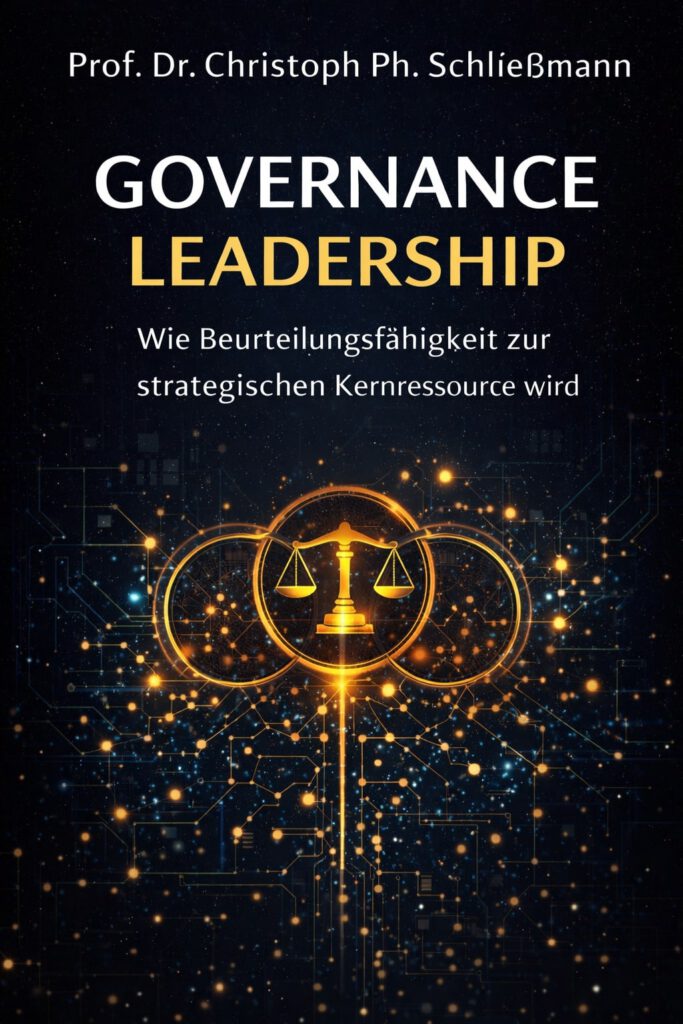
Schließmann, Christoph; Governance Leadership: How judgment becomes a strategic core resource
Amazon: Available as Kindle, paperback, and hardcover. ISBN: 9798279168675
https://www.amazon.de/dp/B0GDLXVJZ3
AI makes output cheap. Judgment becomes scarce.And even scarcer is the evidence that decisions made under pressure are reliable. AI accelerates processes—but not automatically responsibility.Governance Leadershipis the book for executives who don't want to "introduce" AI, but want to make itoperational: fast, secure, explainable. Prof. Dr. Christoph Ph. Schließmann shows why governance in the AI era is not a set of rules, but astrategic management asset: the ability to make decisionsunder time pressure, manage risks, and make resultsverifiableat any time – to customers, auditors, regulators, and, in serious cases, even in court. The book translates the great AI transformation into a clear management approach:building judgment capital.Not as a theory, but as an operation. With short review paths, clear approvals, measurable quality, and consistent learning from incidents. Realistic leadership scenarios (from sales, legal, and purchasing, among others) show how "fast" and "secure" are not contradictions – but require a system that delivers both.Governance Leadershipis an executive operating playbook: a strategic compass for companies that want to not only use AI, but alsomaster it responsibly.
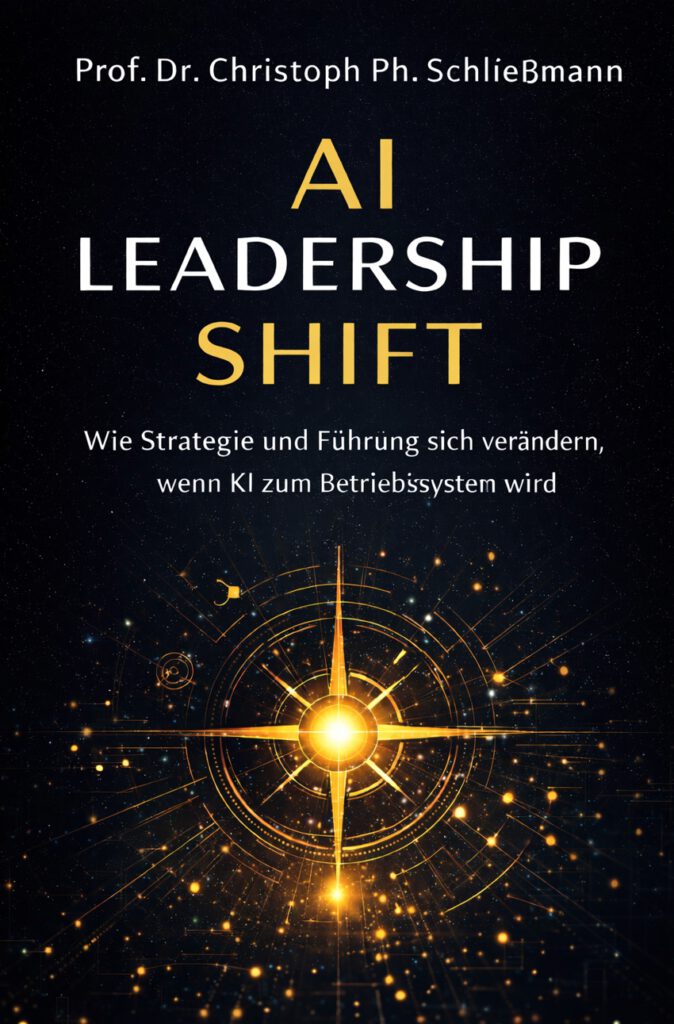
Schließmann, Christoph; AI Leadership Shift: How strategy and leadership change when AI becomes the operating system
Amazon: Available as Kindle and paperback. ISBN: 9798279168675
https://www.amazon.de/dp/B0GBXW4D8N
AI Leadership Shiftis a deliberately concise source of inspiration, a book for executives in upper mid-sized companies who want to understand AI not as an IT project, but as a strategic structural shift. When plausible answers become cheap, evaluation and assessment become scarce—and leadership becomes visible again. This book shows how competition, value creation, and responsibility shift as soon as AI becomes the operating system of the organization. In it, I combine Richard Susskind's transformation logic (decomposition, standardization, externalization, "AI-empowered client") with the interdependency approach to the controllability of complex systems. The result is a practical navigation logic for C-level and second-level management: how to gain speed without losing trust. How to turn "almost" into "almost but verified." And how to design decisions, governance, roles, and culture so that AI does not become an illusion of control, but a source of resilient value creation. You will not receive a list of tools, but rather guidance: which services will become standard in the future, where your competitive advantage lies, how results-based models work in practice, which decision-making rules avoid false precision – and how leadership as a design task secures transformation in the long term.